How Computers Work: The CPU and Memory
Figure 1 shows the parts of a computer:
- The Central Processing Unit:
- (CPU),
- Buses,
- Ports and controllers,
- ROM;
- Main Memory (RAM);
- Input Devices;
- Output Devices;
- Secondary Storage;
- floppy disks,
- hard disk,
- CD-ROM
|
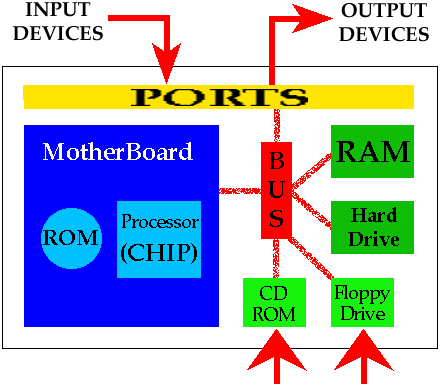 |
| Figure 1: Inside The
Computer | |
This part of
the reading will examine the CPU, Buses, Controllers, and Main Memory. Other
sections will examine input devices, output devices, and secondary memory.
The Central Processing Unit (CPU)
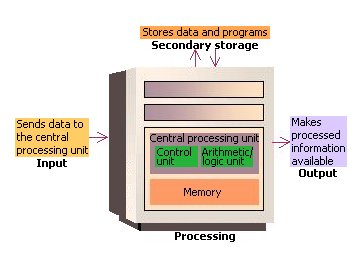 |
| Figure 2: The Central Processing
Unit |
The computer does its primary work in a part
of the machine we cannot see, a control center that converts data input to
information output. This control center, called the central processing unit
(CPU), is a highly complex, extensive set of electronic circuitry that executes
stored program instructions. All computers, large and small, must have a central
processing unit. As Figure 2 shows, the central processing unit consists of two
parts: The control unit and the arithmetic/logic unit. Each part has a specific
function.
Before we discuss the control unit and the arithmetic/logic unit in
detail, we need to consider data storage and its relationship to the central
processing unit. Computers use two types of storage: Primary storage and
secondary storage. The CPU interacts closely with primary storage, or main
memory, referring to it for both instructions and data. For this reason this
part of the reading will discuss memory in the context of the central processing
unit. Technically, however, memory is not part of the CPU.
Recall that a
computer's memory holds data only temporarily, at the time the computer is
executing a program. Secondary storage holds permanent or semi-permanent data on
some external magnetic or optical medium. The diskettes and CD-ROM disks that
you have seen with personal computers are secondary storage devices, as are hard
disks. Since the physical attributes of secondary storage devices determine the
way data is organized on them, we will discuss secondary storage and data
organization together in another part of our on-line readings.
Now let
us consider the components of the central processing unit.
The Control Unit
The control unit of the CPU contains circuitry that
uses electrical signals to direct the entire computer system to carry out, or
execute, stored program instructions. Like an orchestra leader, the control unit
does not execute program instructions; rather, it directs other parts of the
system to do so. The control unit must communicate with both the
arithmetic/logic unit and memory.
The Arithmetic/Logic Unit
The arithmetic/logic unit (ALU) contains
the electronic circuitry that executes all arithmetic and logical operations.
The arithmetic/logic unit can perform four kinds of arithmetic
operations, or mathematical calculations: addition, subtraction, multiplication,
and division. As its name implies, the arithmetic/logic unit also performs
logical operations. A logical operation is usually a comparison. The unit can
compare numbers, letters, or special characters. The computer can then take
action based on the result of the comparison. This is a very important
capability. It is by comparing that a computer is able to tell, for instance,
whether there are unfilled seats on airplanes, whether charge- card customers
have exceeded their credit limits, and whether one candidate for Congress has
more votes than another.
Logical operations can test for three
conditions:
- Equal-to condition. In a test for this condition, the
arithmetic/logic unit compares two values to determine if they are equal. For
example: If the number of tickets sold equals the number of seats in the
auditorium, then the concert is declared sold out.
- Less-than condition. To test for this condition, the computer
compares values to determine if one is less than another. For example: If the
number of speeding tickets on a driver's record is less than three, then
insurance rates are $425; otherwise, the rates are $500.
- Greater-than condition. In this type of comparison, the computer
determines if one value is greater than another. For example: If the hours a
person worked this week are greater than 40, then multiply every extra hour by
1.5 times the usual hourly wage to compute overtime pay.
A
computer can simultaneously test for more than one condition. In fact, a logic
unit can usually discern six logical relationships: equal to, less than,
greater than, less than or equal to, greater than or equal to, and not
equal.
The symbols that let you define the type of comparison you
want the computer to perform are called relational operators. The most common
relational operators are the equal sign(=), the less-than symbol(<), and the
greater-than symbol(>).
- Registers: Temporary Storage Areas
Registers are temporary storage
areas for instructions or data. They are not a part of memory; rather they are
special additional storage locations that offer the advantage of speed.
Registers work under the direction of the control unit to accept, hold, and
transfer instructions or data and perform arithmetic or logical comparisons at
high speed. The control unit uses a data storage register the way a storeowner
uses a cash register-as a temporary, convenient place to store what is
used in transactions.
Computers usually assign special roles to
certain registers, including these registers:
- An accumulator, which collects the result of computations.
- An address register, which keeps track of where a given
instruction or piece of data is stored in memory. Each storage location in
memory is identified by an address, just as each house on a street has an
address.
- A storage register, which temporarily holds data taken from or
about to be sent to memory.
- A general-purpose register, which is used for several functions.
- Memory and Storage
Memory is also known as primary storage,
primary memory, main storage, internal storage, main memory, and RAM (Random
Access Memory); people in computer circles use all of these terms interchangeably.
Memory is the part of the computer that holds data and instructions
for processing. Although closely associated with the central processing unit,
memory is separate from it. Memory stores program instructions or data for
only as long as the program they pertain to is in operation. Keeping these
items in memory when the program is not running is not feasible for three
reasons:
- Most types of memory only store items while the computer is turned on;
data is destroyed when the machine is turned off.
- If more than one program is running at once (often the case on large
computers and sometimes on small computers), a single program cannot lay
exclusive claim to memory.
- There may not be room in memory to hold the processed data.
How do data and instructions get from an input device into
memory? The control unit sends them. Likewise, when the time is right, the
control unit sends these items from memory to the arithmetic/logic unit, where
an arithmetic operation or logical operation is performed. After being
processed, the information is sent to memory, where it is held until it is
ready to be released to an output unit.
The chief characteristic of
memory is that it allows very fast access to instructions and data, no matter
where the items are within it. We will discuss the physical components of
memory-memory chips-later in this chapter.
To see how registers, memory, and second storage all work together, let
us use the analogy of making a salad. In our kitchen we have:
- a refrigerator where we store our vegetables for the salad;
- a counter where we place all of our veggies before putting them on the
cutting board for chopping;
- a cutting board on the counter where we chop the vegetables;
- a recipe that details what veggies to chop;
- the corners of the cutting board are kept free for partially chopped
piles of veggies that we intend to chop more or to mix with other partially
chopped veggies.
- a bowl on the counter where we mix and store the salad;
- space in the refrigerator to put the mixed salad after it is made.
The process of making the salad is then: bring the veggies from the
fridge to the counter top; place some veggies on the chopping board according
to the recipe; chop the veggies, possibly storing some partially chopped
veggies temporarily on the corners of the cutting board; place all the veggies
in the bowl to either put back in the fridge or put directly on the dinner
table.
The refrigerator is the equivalent of secondary (disk) storage. It can
store high volumes of veggies for long periods of time. The counter top is the
equivalent of the computer's motherboard - everything is done on the counter
(inside the computer). The cutting board is the ALU - the work gets done
there. The recipe is the control unit - it tells you what to do on the cutting
board (ALU). Space on the counter top is the equivalent of RAM memory - all
veggies must be brought from the fridge and placed on the counter top for fast
access. Note that the counter top (RAM) is faster to access than the fridge
(disk), but cannot hold as much, and cannot hold it for long periods of
time. The corners of the cutting board where we temporarily store partially
chopped veggies are equivalent to the registers. The corners of the cutting
board are very fast to access for chopping, but cannot hold much. The salad
bowl is like a temporary register; it is for storing the salad waiting to take
back to the fridge (putting data back on a disk) or for taking to the dinner
table (outputting the data to an output device).
Now for a more technical example, let us look at how a payroll program
uses all three types of storage. Suppose the program calculates the salary of
an employee. The data representing the hours worked and the data for the rate
of pay are ready in their respective registers. Other data related to the
salary calculation-overtime hours, bonuses, deductions, and so forth-is
waiting nearby in memory. The data for other employees is available in
secondary storage. As the CPU finishes calculations about one employee, the
data about the next employee is brought from secondary storage into memory and
eventually into the registers.
The following table summarizes the characteristics of the various kinds of
data storage in the storage hierarchy.
| Storage |
Speed |
Capacity |
Relative Cost ($) |
Permanent? |
| Registers |
Fastest |
Lowest |
Highest |
No |
| RAM |
Very Fast |
Low/Moderate |
High |
No |
| Floppy Disk |
Very Slow |
Low |
Low |
Yes |
| Hard Disk |
Moderate |
Very High |
Very Low |
Yes |
Modern computers are
designed with this hierarchy due to the characteristics listed in the table.
Hard disks have been the cheapest way to get the functionality. However, as RAM becomes
cheaper, faster, and even permanent, we will see disks disappear as an internal
storage device. Removable disks, like Zip disks or CDs (we describe these in
detail in the online reading on storage devices) will remain in use
longer as a means to physically transfer large volumes of data into the
computer. However, even this use of disks will probably be supplanted by the
Internet as the major (and eventually only) way of transferring data. Floppy
disk drives are already disappearing and will continue to disappear as storage technology
advances.
For more detail on the computer's memory hierarchy, see the How Stuff Works pages
on computer memory.. This is optional reading.
- How the CPU Executes Program Instructions
Let us examine the way
the central processing unit, in association with memory, executes a computer
program. We will be looking at how just one instruction in the program is
executed. In fact, most computers today can execute only one instruction at a
time, though they execute it very quickly. Many personal computers can execute
instructions in less than one-millionth of a second, whereas those speed
demons known as supercomputers can execute instructions in less than
one-billionth of a second.
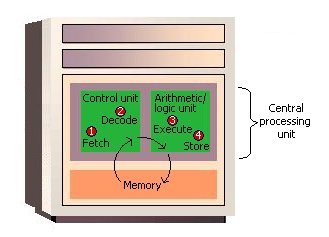 |
| Figure 3: The Machine
Cycle |
Before an instruction can be executed,
program instructions and data must be placed into memory from an input device
or a secondary storage device (the process is further complicated by the fact
that, as we noted earlier, the data will probably make a temporary stop in a
register). As Figure 3 shows, once the necessary data and instruction are in
memory, the central processing unit performs the following four steps for each
instruction:
- The control unit fetches (gets) the instruction from memory.
- The control unit decodes the instruction (decides what it means) and
directs that the necessary data be moved from memory to the arithmetic/logic
unit. These first two steps together are called instruction time, or I-time.
- The arithmetic/logic unit executes the arithmetic or logical
instruction. That is, the ALU is given control and performs the actual
operation on the data.
- The arithmetic/logic unit stores the result of this operation in memory
or in a register. Steps 3 and 4 together are called execution time, or
E-time.
The control unit eventually directs memory to release
the result to an output device or a secondary storage device. The combination
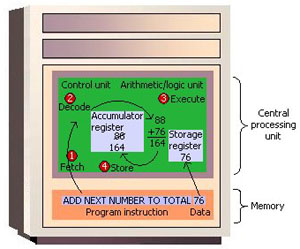
of I-time and E-time is called the machine cycle. Figure 4 shows an
instruction going through the machine cycle.
Each central processing
unit has an internal clock that produces pulses at a fixed rate to synchronize
all computer operations. A single machine-cycle instruction may be made up of
a substantial number of sub-instructions, each of which must take at least one
clock cycle. Each type of central processing unit is designed to understand a
specific group of instructions called the instruction set. Just as there are
many different languages that people understand, each different type of CPU
has an instruction set it understands. Therefore, one CPU-such as the one for
a Compaq personal computer-cannot understand the instruction set from another
CPU-say, for a Macintosh.
|
| Figure 4: The Machine Cycle in
Action |
It is one thing to have instructions and data somewhere in memory and quite
another for the control unit to be able to find them. How does it do this?
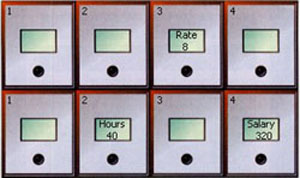
|
| Figure 5: Memory Addresses Like
Mailboxes |
The location in memory for each
instruction and each piece of data is identified by an address. That is, each
location has an address number, like the mailboxes in front of an apartment
house. And, like the mailboxes, the address numbers of the locations remain
the same, but the contents (instructions and data) of the locations may
change. That is, new instructions or new data may be placed in the locations
when the old contents no longer need to be stored in memory. Unlike a mailbox,
however, a memory location can hold only a fixed amount of data; an address
can hold only a fixed number of bytes - often two bytes in a modern computer.
Figure 5 shows how a program manipulates data in memory. A payroll
program, for example, may give instructions to put the rate of pay in location
3 and the number of hours worked in location 6. To compute the employee's
salary, then, instructions tell the computer to multiply the data in location
3 by the data in location 6 and move the result to location 8. The choice of
locations is arbitrary - any locations that are not already spoken for can be
used. Programmers using programming languages, however, do not have to worry
about the actual address numbers, because each data address is referred to by
a name. The name is called a symbolic address. In this example, the symbolic
address names are Rate, Hours, and Salary.